The Harvey Mudd, CSU Long Beach, and Uni. of Costa Rica research teams are in Cuajiniquil, Costa Rica for field research. Every morning at 6:30 are treated to breakfast, huevos (estrellados o revueltos) y Gallo Pinto, by our wonderful hosts at Santa Elena Lodge. Gracias don Manuel y familia! Here are some highlights of Days 2 and 3 in the field.
Day 2: Tagging Nurse Sharks & AUV Troubleshooting
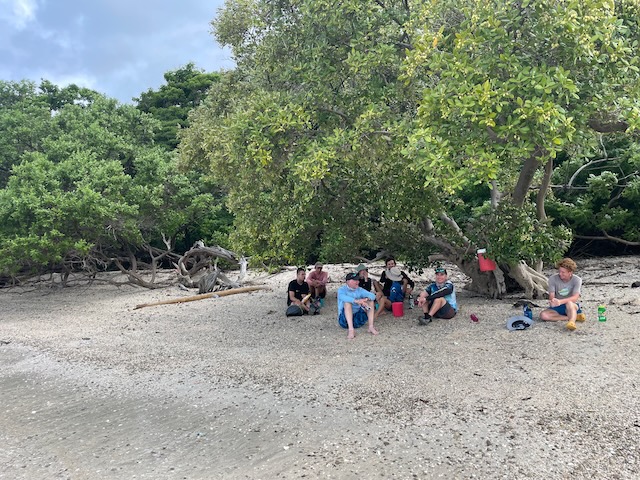
The newbies, like me, must be so frustrating to our seasoned Costa Rican colleagues. Everything is new, which is incredibly exciting for us, but we also slow the pace. The team that was going out on the boat today was ready to go by 7:15, but we forgot a few important things, so it was a while before we got to the field site. By 9 am we were setting out the long line to catch nurse sharks for tagging. We had a lot of animals to tag, it was super productive, but also tiring. Wrangling nurse sharks is tough work, they are very strong animals and do not like to handled by humans. Sergio (Checho) did most of the tagging, but Lucia also got in there, Prof. Lowe and Prof. Espinoza were our experts guides. We all rotated through different roles throughout the day. My favorite task was handling the shark, which involves getting a handle on their pectoral fins to control their movement. After about five hours we had tagged eight sharks, the largest was 2.5m, and we were exhausted. We had lunch on the beach, surrounded by hermit crabs.
 |
Prof. Lowe in the water with his GoPro, filming the crew as they tag a nurse shark along the side of the boat. |
 |
The Day 2 shark tagging crew having an amazing lunch
on the beach, surrounded by hermit crabs. |
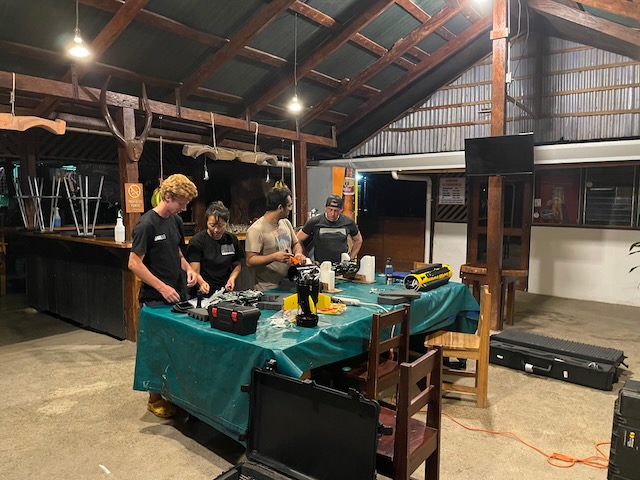
The AUV team was working to get the robot up and running, with some great initial success. During testing in the nearby bay, they lost the wifi connection with the AUV. This was an unfortunate development, back to troubleshooting they went.
 |
Late night robot troubleshooting session. The AUV team is
working hard to get the robot up and running for field work.
It was a tough day, but they're resourceful Mudd engineers,
the AUV will be ready soon.
|
Day 3: Drone Surveys & Diving for Data Loggers
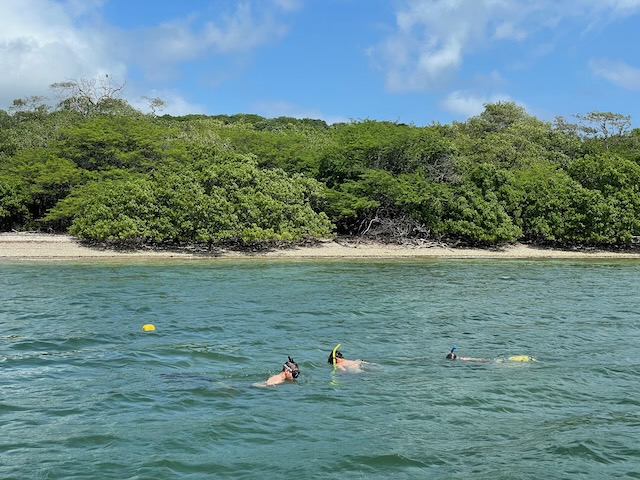
On Day 3, our boat team was smaller. Paola and Lucia were in Cuajiniquil interviewing fisherman to begin quantifying what is being caught by local artisanal fisherman, it's a component of their Citizen Science project. Including the local community in which you're doing field work is critical for developing trust, gaining insight and deep knowledge, and building strong relationships. The AUV team was deep in troubleshooting mode, so they stayed back at the lodge. The SharkLab (Long Beach) and CIMAR (Costa Rica) groups were aiming to get drone surveys of the field site and recover temperature data loggers. To recover the data loggers, someone has to dive down near the expected location, find the logger, snip a couple of zip ties and bring it back up to the surface. Then the data is downloaded and the data logger goes back down to be secured. I probably should've stayed behind too. I don't have much experience snorkeling, so I definitely was not comfortable enough for free-diving. Jaden was a lot of help, Mario (Prof. Espinoza) joked that he wants to hire him for future field work. I don't think he was joking. Despite the terrible visibility, all five of the temperature loggers were recovered, even the one that was "missing" on the first attempt. We went back to the dive shop for lunch, where the rest of the crew met up with us. Today we had seafood fried rice! The afternoon was full of computer work and, for the AUV team, lots of cables and electrical tape.
 |
Jaden and SharkLab students Javi and Felicity hunting
for temperature data loggers. |
 |
Drone surveys of the field site. We got sharks,
eagle spotted rays, a turtle, and a crocodile on
video. |
 |
The Harvey Mudd AUV team working hard to get the robot
ready for field work. There are a lot of components, it's
amazing how they can take this machine apart, fix it, and
put it all back together. |
That's all for Days 2 and 3. Prof. Soto (Alberto) signing off...breakfast is in 7 hours.